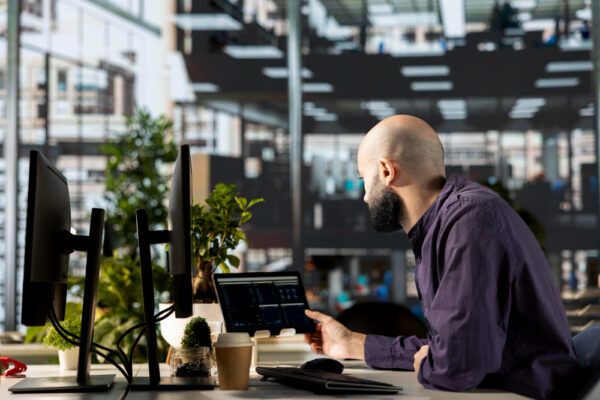



The modern office is changing radically. Where employees once sat at the same desk for years on end, they now choose a workspace each day to suit the task at hand. This shift towards Activity Based Working (ABW) is no longer a trend, it's a necessity. With 63% of large Dutch companies now allowing at least three days of home working, organisations need to fundamentally rethink their office space.
What exactly is Activity Based Working?
Activity Based Working comes down to a simple principle: you choose your workspace based on what you're doing, not on who you are. You take a phone call in a call booth, brainstorm in an open collaboration space, and head to a quiet concentration zone for deep-focus work. The office changes from a collection of fixed desks into a dynamic landscape of different work zones.
This approach has a direct impact on the amount of floor space companies need. Where traditional offices allow for 16.5 m² per employee, organisations using ABW can get by with 14.3 m² by 2030. That's a saving of 8 to 15% in office space, a significant amount given rents of €400 to €500 per m² in prime locations such as Amsterdam's Zuidas.
The new reality: office as meeting place
The office of 2025 is no longer somewhere you go to work alone, but somewhere you come to work together. With an average occupancy rate of just 59%, down from 65% before the pandemic, it's clear that the function of office space has fundamentally changed. Focused individual work increasingly happens at home, while the office is developing into a place for collaboration, knowledge-sharing and team building.
This shift calls for different kinds of spaces. Companies are now investing in:
- Hybrid meeting rooms for video calls with colleagues working from home
- Concentration zones with good acoustic treatment, making up 20 to 25% of the space
- Collaboration zones for brainstorming and project work, 15 to 20%
- Relaxation areas and social meeting spaces
- Flexible workstations with modern technology
The challenges of flexible working
Not everything about ABW is plain sailing. The biggest complaint is noise disturbance. Open-plan offices can reduce productivity on focused work by 15 to 20%. Meanwhile, 64% of employees still prefer having a fixed desk. This tension between flexibility and the need for a space to call your own is a serious challenge.
Privacy is another key concern. Confidential conversations in an open space, sensitive documents on a shared desk, and colleagues glancing at your screen are real worries that need addressing. Successful ABW rollouts tackle this with separate meeting rooms, call booths and clear codes of conduct.
Implementation: more than just moving furniture around
The transition to Activity Based Working takes more than a new floor plan. It's a cultural shift that starts with trust. Managers need to let go of the idea that presence equals productivity. Employees need to get used to no longer having a desk of their own.
A successful rollout follows these steps:
- Baseline measurement (2 to 4 weeks): Measure current occupancy and analyse which activities happen where
- Developing a vision (2 to 4 weeks): Work with the team to define the ideal working environment and set a budget
- Design (4 to 6 weeks): Define the different zones and work out the fit-out
- Execution (4 to 12 weeks): Carry out the refit in phases, ideally during holiday periods
- Training (1 to 2 weeks): Guide employees through the new way of working with tours and clear ground rules
- Monitoring (ongoing): Measure occupancy, gather feedback and adjust where needed
The financial reality
ABW promises cost savings, but the reality is more nuanced. You save on floor space, but investment in high-quality fit-out, acoustic treatment and technology can quickly add up to €30,000 to €100,000. On top of that, shorter leases, popular for their flexibility, often come with a premium of 10 to 20%.
For small teams of 5 to 10 people, ABW often isn't cost-effective. The complexity and cost outweigh the limited space savings. It's only in organisations of around 40 employees or more that the benefits really become apparent, especially where hybrid working is the norm.
Sustainability as the new standard
One notable trend is that many companies are choosing more expensive offices despite the space savings. The reason is that sustainability and location matter more than ever. With 82% of Dutch offices now meeting energy label C or better, and reporting rules pushing companies towards more sustainable practices, sustainable buildings have become the new norm. These cost 20 to 30% more, but offer lower energy costs and a better impression for clients and prospective talent.
Employees, too, are setting the bar higher. Research shows that 92% are willing to come into the office if the facilities are better. Fresh air, natural light, good coffee and opportunities to unwind make the difference between an empty office and a buzzing one.
The future of work
Activity Based Working isn't a final destination, but an ongoing process. With demand for office space expected to fall by 8.7% by 2030, companies need to become more agile. The winning formula combines space savings with investment in quality. A smaller but better office in a prime location with excellent facilities attracts talent and encourages collaboration.
The lesson for businesses is clear: ABW works, but only with the right approach. It requires committed management, active employee participation and continuous fine-tuning. For organisations willing to make this investment, a more efficient, dynamic and appealing working landscape is within reach. The office of the future is already here, we just need to learn how to make the most of it.


 info@deskfinder.nl